Patrols are the backbone of most security operations.
Whether guarding commercial properties, residential sites, or industrial locations, patrols are how security teams demonstrate presence, consistency, and accountability. Yet for many companies, patrol tracking is either overly manual or unnecessarily complex.
This guide explains the most common patrol tracking methods used by modern security teams: QR codes, NFC checkpoints, and GPS-based tracking. It describes how to choose the right approach without overengineering your operations.
The goal is not to recommend a specific technology, but to help you understand how patrol tracking works in real-world security operations.
1. Why patrol tracking matters
Patrol tracking is not about surveillance. It is about verification and consistency.
When patrols are tracked effectively, teams can:
- Confirm that patrols were completed as expected
- Identify missed or delayed patrols early
- Provide clear proof of service to clients
- Reduce manual follow-ups and paperwork
Without tracking, patrols rely heavily on trust and end-of-shift reporting. While trust is essential, lack of verification creates gaps; especially as teams grow or manage multiple sites.
Modern patrol tracking provides clarity without requiring constant supervision.
2. Common problems with patrol tracking
Many patrol systems fail not because of the technology, but because of how they are designed or applied.
Common issues include:
- Too many checkpoints with little operational value
- Complicated patrol routes that are hard to follow
- Manual logs that are filled out after the fact
- Tracking methods that slow guards down
When patrols feel burdensome, guards rush through them or disengage altogether. When supervisors receive inconsistent data, patrol tracking loses credibility.
Good patrol tracking is simple, repeatable, and aligned with the actual site layout.
3. QR code patrol tracking
QR codes are one of the most common patrol tracking methods used today.
How it works
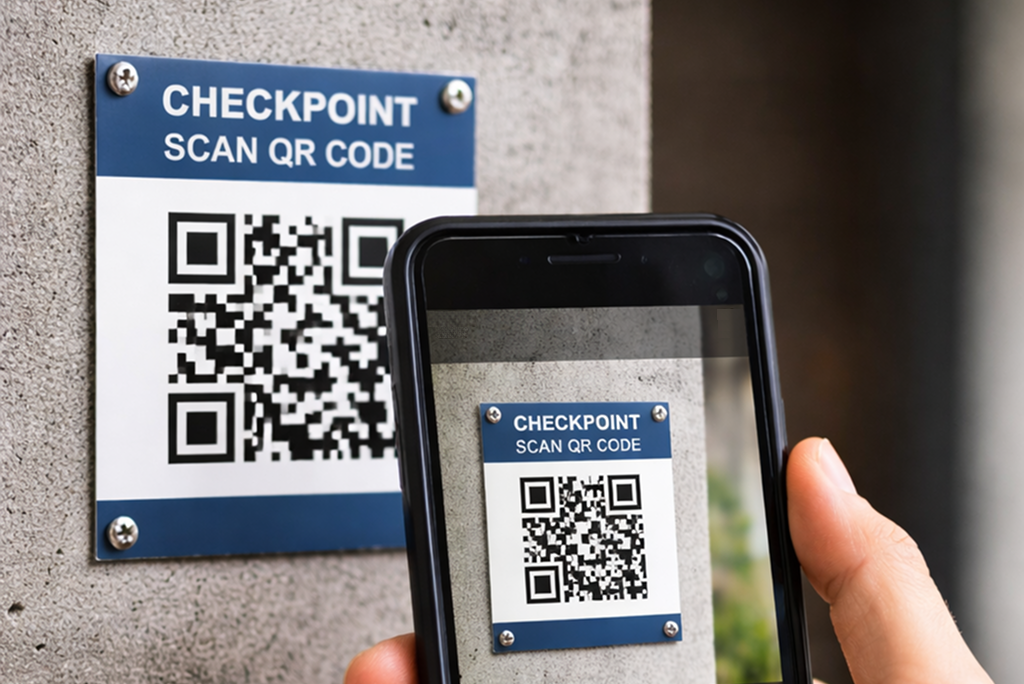
QR codes are placed at designated patrol points. Guards scan the code using a mobile app during their patrol.
When QR codes work well
- Indoor or outdoor sites with fixed patrol points
- Teams that want low-cost, easy-to-deploy tracking
- Operations where guards already use smartphones
Considerations
- Codes must be placed securely to prevent tampering
- Scanning requires the guard to physically reach the location
- Lighting and weather conditions should be considered
QR codes are simple, accessible, and effective when patrol routes are clearly defined.
4. NFC checkpoint patrol tracking
NFC checkpoints use short-range communication, typically requiring a guard to tap their phone against a physical tag.
How it works
NFC tags are installed at patrol points. Guards tap their device to the tag to record completion.
When NFC works well
- Sites where precise location confirmation is important
- Environments where scanning may be unreliable
- Operations that want a more tamper-resistant option
Considerations
- NFC tags require compatible devices
- Installation is slightly more involved than QR codes
- Tags must be maintained over time
NFC tracking provides strong verification while remaining quick and intuitive for guards.
5. GPS-based patrol tracking
GPS tracking verifies patrol activity based on location data rather than fixed checkpoints.
How it works
The system records guard movement and location during a shift or patrol window.
When GPS works well
- Large outdoor sites
- Mobile patrol routes
- Locations without fixed checkpoints
Considerations
- GPS accuracy can vary by environment
- Continuous tracking may feel intrusive if not clearly explained
- Battery usage should be monitored
GPS tracking is best used to confirm presence and coverage rather than replace structured patrol points.
6. Choosing the right approach for your operation
There is no single "best" patrol tracking method.
Well-run security teams:
- Match the tracking method to the site type
- Keep patrol requirements realistic
- Avoid adding checkpoints that do not improve safety or accountability
- Start simple and adjust based on feedback
Many operations use a combination of methods depending on the site. The key is consistency, not complexity.
7. What good patrol tracking looks like in practice
In effective security operations:
- Guards complete patrols confidently without confusion
- Patrol routes match the physical layout of the site
- Supervisors can verify patrol completion without follow-ups
- Clients receive clear documentation when needed
Patrol tracking becomes a quiet, reliable part of daily operations rather than a constant point of friction.
Patrol tracking works best when it supports the way guards already operate.
Whether using QR codes, NFC checkpoints, or GPS tracking, the most successful teams focus on clarity, simplicity, and alignment with real-world conditions. Technology should reinforce good processes, not complicate them.
Modern security platforms, like Opspot, are designed to support flexible patrol tracking approaches, but lasting success always comes from thoughtful setup and steady adoption.